










A 12th-century statue of a transgender woman has been found near Palani.
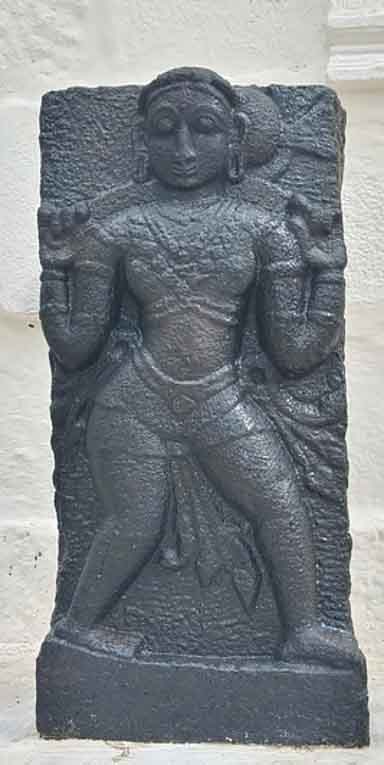
Tamil Nadu: A 12th-century statue of a transgender woman, Navakanda, has been found in a ruined temple on the banks of the Kudhiriyar River near Palani.
A Thalapally statue has been found in a ruined temple on the banks of the Kudhiriyar River near Kollam, on the border of Dindigul district, near Palani.
Archaeologist Narayana Murthy, who examined the statue, said: “Generally, animals like goats and chickens are sacrificed to the gods. Similarly, sacrificing oneself voluntarily without any pressure is called self-sacrifice.”
The statue found is also a self-sacrifice statue. The statue is designed to resemble a transgender woman with a headdress and ornaments. It is also called a Navakanda statue.
After their death, villagers typically create statues in their memory. Such self-sacrifices are offered to the deity Kotravai as a prayer. It was customary for the people and the government to donate land for the livelihood of the family of the sacrificer. Several inscriptions in Tamil Nadu indicate that the land given for such sacrifices was called “Uthirapatti,” “Navakani,” “Neethopatti,” “Uthirakani,” and so on.
Here, the transgender woman who sacrifices herself is seen wearing beautifully carved clothing and accessories. She also appears with a beautiful braid, a comb on her forehead, and a headband. Jewelry such as necklaces, necklaces, and a bracelet are around her neck. The statue has a long sword tucked behind her neck. She is wearing clothing that reaches only from the waist to her thighs.
The tufts on both sides of her waist and in front confirm her dancer status. Therefore, it can be assumed that she was the goddess from the nearby Kollam Veera Choleswarar Temple. Since the statue has no inscriptions, it is impossible to determine its details. Based on the design of the statue, it can be confirmed that it dates back to the 12th century AD.
An inscription at the Veeracholeswara Temple in Colombo, dating back to the 8th reign of Kongu Chola king Vira Narayana, mentions a goddess named ‘Thiruvin Nangai’ in the temple, suggesting that the woman sacrificed, Navakandam, was a dancer, the temple deity, and a transgender woman. Since the pond near this statue is also called Devi Kulam, it is possible that the pond was named after the woman sacrificed.
An inscription engraved by Vira Chola’s minister at his behest at the Veeracholeswara Temple in Colombo mentions a Kotravai temple named Kalapitiri Temple in the coastal area. Therefore, this ruined temple may be considered the Kotravai temple, also known as the Pitari Temple. It is unknown why this transgender woman sacrificed herself.
The Mahabharata mentions Aravan performing the Navakandam before the Kurukshetra War. It is possible that he sacrificed himself for one of his king’s wars. Based on this, it can be assumed that the Navakandam was performed here. He said this is the first transgender Navakandam statue found in Tamil Nadu.