










PM Modi stressed on promoting natural farming and sustainable agriculture
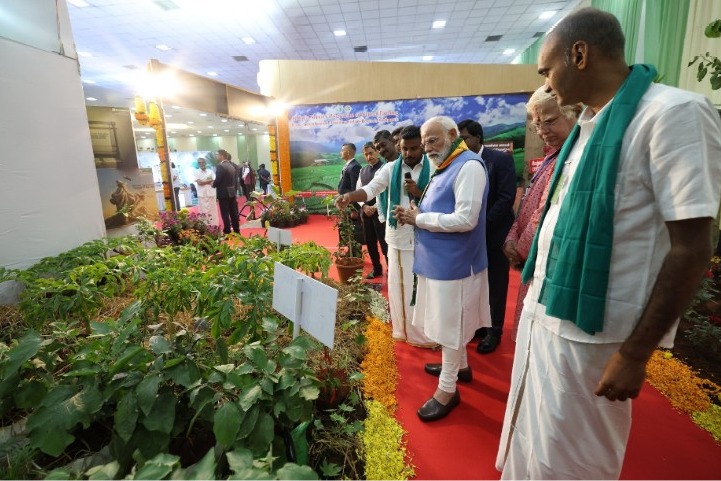
New Delhi: Prime Minister Narendra Modi on Wednesday praised India’s progress in natural farming. He cited central government initiatives such as the National Mission on Natural Farming, measures to promote exports, and a significant increase in institutional credit through Kisan Credit Cards, as well as PM-Kisan, as having strengthened farmers engaged in natural farming practices.
In a LinkedIn post titled ‘India and Natural Farming… The Way Forward!’, the Prime Minister recalled his meeting with a group of farmers from Tamil Nadu in August, where they shared how they were adopting new farming methods to increase sustainability and productivity. He invited them to the South India Natural Farming Summit 2025, to be held in Coimbatore on November 19.
He wrote, “So, a few weeks ago, on November 19th, I was in the lovely city of Coimbatore to attend the South India Natural Farming Summit 2025. A city considered the backbone of MSMEs was hosting a major event on natural farming.” He explained that natural farming is based on India’s traditional knowledge systems as well as modern ecological principles, allowing farming without synthetic chemicals. It promotes diverse farms where plants, trees, and animals coexist to support natural biodiversity. This approach emphasizes recycling farm waste and improving soil health through mulching and aeration, rather than relying on external inputs.
PM Modi said, “This summit in Coimbatore will always be a part of my memories! It demonstrated the shift in thinking, imagination, and confidence with which India’s farmers and agri-entrepreneurs are shaping the future of agriculture.” He further stated that he spoke with farmers in Tamil Nadu who demonstrated their work in natural farming, and was “amazed.”
He said he met people with remarkable backgrounds and life journeys, including a farmer who managed approximately 10 acres of multi-layered farming, including bananas, coconuts, papayas, peppers, and turmeric, and also raised 60 indigenous cows, 400 goats, and local poultry.
He also mentioned another farmer who is committed to preserving traditional rice varieties like Mappillai Samba and Karuppu Kavuni, and focuses on value-added products like health mixes, puffed rice, chocolates, and protein bars.
He spoke of a first-generation graduate who runs a 15-acre natural farm, has trained over 3,000 farmers, and supplies approximately 30 tons of vegetables each month.
He further stated that some FPOs are supporting tapioca farmers and promoting tapioca-based products as sustainable raw materials for bioethanol and compressed biogas.
He further highlighted the contributions of agri-innovators, including a biotechnology professional who created a seaweed-based biofertilizer enterprise that employs 600 fishermen in coastal districts, and another who developed nutrient-rich bioactive biochar that improves soil health. He said both demonstrated how science and sustainability can be easily integrated.
According to him, despite coming from different backgrounds, everyone he met shared a strong commitment to soil health, sustainability, community well-being, and business.
The Prime Minister emphasized that India has made “tremendous progress” in natural farming at the national level.
He said, “Last year, the Government of India launched the National Mission on Natural Farming, which has already engaged millions of farmers in sustainable farming practices. Across the country, thousands of hectares of land are being cultivated in natural farming. Government efforts, such as promoting exports, Kisan Credit Cards (including for livestock and fisheries), and significantly increasing institutional credit through PM-KISAN, have also helped farmers adopt natural farming.”
He further stated that natural farming is closely linked to the central government’s efforts to promote Sri Anna, or millet, and said it is a good thing that more women farmers are adopting natural farming.
PM Modi pointed out that over the past few decades, increasing reliance on chemical fertilizers and pesticides has damaged soil fertility, reduced moisture, and increased farming costs, impacting long-term sustainability.
He said that natural farming directly addresses these concerns, with the use of Panchagavya, Jeevamrit, Beejamrit, and mulching helping to protect soil health, reduce chemical exposure, lower input costs, and increase resilience to climate change and extreme weather.
He said, “I encouraged farmers to start with ‘one acre, one season.’ Results from even a small plot can instill confidence and inspire large-scale adoption. When traditional knowledge, scientific validation, and institutional support come together, natural farming can become possible and transformative.”
He urged people to consider natural farming through FPOs, which he described as strong platforms for collective empowerment, and suggested locating startups in the natural farming ecosystem.