










Students received training in beekeeping
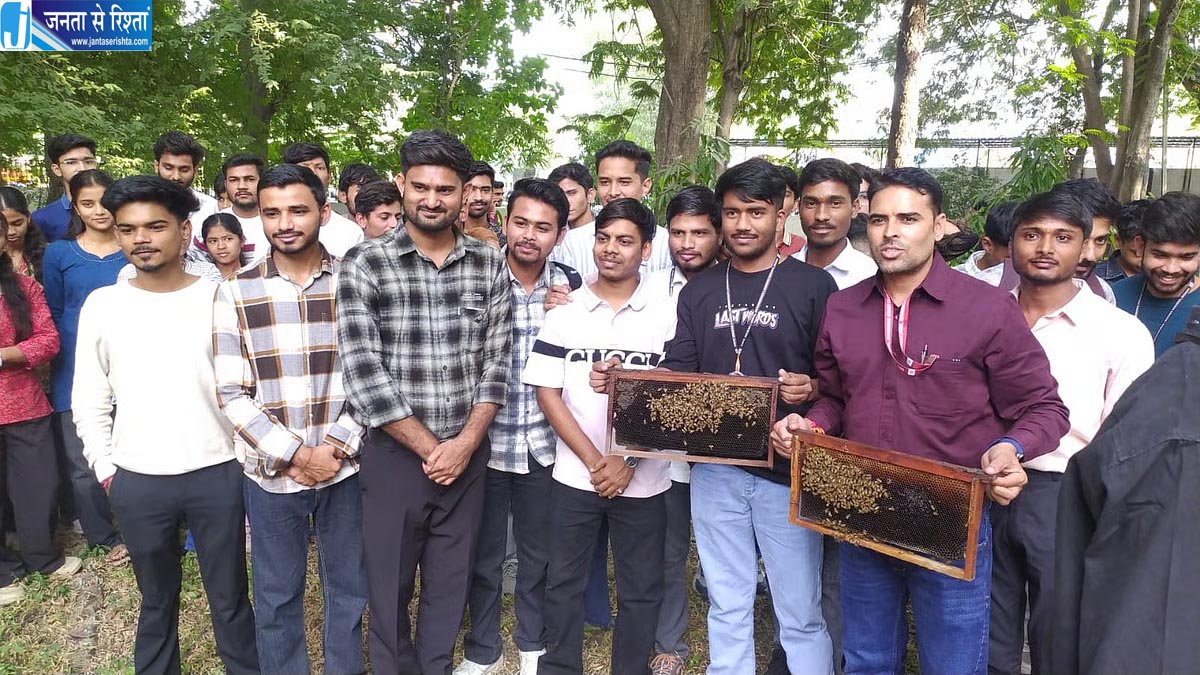
Indore. A five-day workshop is being organized at the Government Holkar (Model, Autonomous) Science College, Indore, Madhya Pradesh with the aim of connecting students with modern agricultural techniques and self-employment opportunities. More than 400 students are participating every day in this workshop organized by the Seed Technology Department of the college. Through the workshop, students are being given practical information on important subjects like seed technology, crop protection, pest control, agricultural entrepreneurship and beekeeping. Its objective is to prepare students for employment and business possibilities in the agricultural sector along with traditional education.
On the fourth day of the workshop, special training was given on identification of pests and various diseases affecting crops, modern methods of their control and developing self-employment through beekeeping. In the program, experts told the students that farming can be made more productive and profitable by adopting modern technologies and scientific methods.
More than 400 students are taking agricultural technology training
The five-day workshop organized at Government Holkar Science College is becoming an opportunity for the students to get new information related to agricultural science and entrepreneurship. More than 400 students are participating in this program every day.
In the workshop, students are being given information about various aspects related to seed technology and agriculture. Under this, emphasis has been laid on increasing the quality of crops, keeping plants safe from pests and diseases and understanding modern agricultural methods.
Experts believe that adopting scientific approach in agriculture sector can improve the quality of production. Besides, youth may also get opportunities to start new businesses related to farming.
Taught to identify pests and diseases in crops
On the fourth day of the workshop, students were trained to identify different types of pests and diseases affecting crops. Experts said that it is very important to timely identify any disease or insect infection in the crop.
If farmers identify the problem at an early stage, the damage to crops can be reduced to a great extent. For this, regular inspection, assessment of the condition of plants and adoption of correct treatment method is necessary.
During the training, students were given information about modern methods of pest control. The role of crop protection in agricultural production was also explained.
Emphasis on importance of integrated pest management
In the workshop, Professor Ashok Jat explained to the students in detail about the importance of Integrated Pest Management (IPM).
He explained the usefulness of scientific techniques by highlighting the possibilities of increasing income in the field of agriculture.
Integrated pest management is a method in which balanced use of biological, mechanical, agronomic and, if necessary, chemical measures is made to protect crops from pests.
The purpose of this method is to control economic losses caused by pests and reduce the use of unnecessary chemical pesticides.
Through this, along with controlling the cost of farming, it can also help in protecting the environment and beneficial insects.
Self employment opportunities through beekeeping
A major attraction of the workshop was the practical training in beekeeping. The students were told that beekeeping is not limited to honey production only, but it is also a useful agriculture based business.
Through beekeeping, youth can move towards self-employment with low or medium level investment. Apart from honey, there is a possibility of earning income through wax and other products from beekeeping.
Apart from this, bees play an important role in pollination of crops and fruit plants. This can help in increasing the productivity and quality of many crops.
Students were introduced to the practical aspects of beekeeping and the possibilities of linking it with entrepreneurship.
Motivation to achieve goals with moral values
Dr. Mala Singh Thakur, who was present as the chief guest in the program, addressed the students. He inspired the students to give importance to moral values in their life and make continuous efforts to achieve the set goals.
He encouraged the students to develop good character, discipline and a sense of responsibility along with education.
The program also emphasized that students should not be limited to academic achievements only, but should use their knowledge and skills for the development of the society and self-reliance.
Discussion on possibilities of increasing income in agriculture sector
In the training programme, special attention was also given to the topic of linking agriculture with employment and entrepreneurship. Experts informed the students about the various possibilities available in the agriculture sector.
Seed production, crop protection, agricultural consultancy, beekeeping and agro-based small businesses are the areas in which employment opportunities can develop for trained youth.
Youth having knowledge of modern technologies can start businesses as per their expertise in these fields.
Students will benefit from practical education
The five-day workshop aims to provide students with practical experience along with the theoretical knowledge acquired in the classroom. agriculture and