










Sudan Crisis: Sudanese Fleeing Clashes Overwhelm Port City, Borders With Egypt
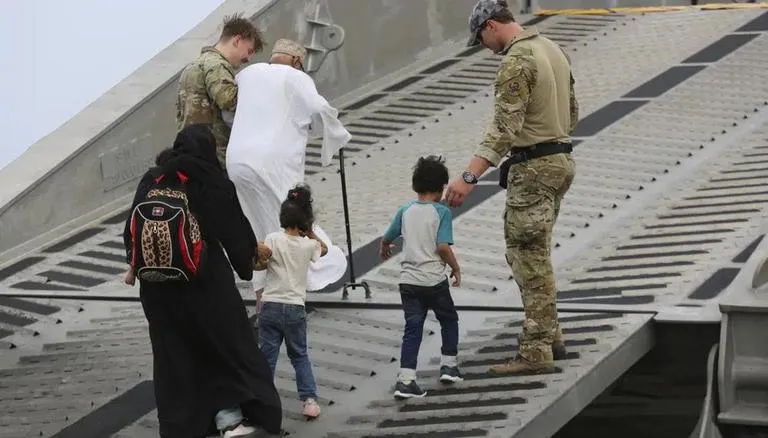
Sudanese fleeing the fighting between rival generals in their capital flooded an already overwhelmed city on the Red Sea and Sudan’s northern borders with Egypt, as explosions and gunfire echoed Monday in Khartoum.
Many exhausted Sudanese and foreigners arrived in Port Sudan, the country’s main seaport, joining thousands who have waited for days to be evacuated out of the chaos-stricken nation. Others have been driven in packed buses and trucks, seeking shelter in Egypt, Sudan’s northern neighbor.
“Much of the capital has become empty,” said Abdalla al-Fatih, a Khartoum resident, “all (residents of) our street fled the war.”
The fighting, now in its third week, has turned Khartoum and its neighboring city of Omdurman into a battlefield. Fierce clashes taking place inside residential neighborhoods that have become “ghost areas,” residents say.
The conflict, which capped months of worsening tensions, pits the military, led by Gen. Abdel-Fattah Burhan, against a rival paramilitary group called the Rapid Support Forces, commanded by Gen. Mohamed Hamdan Dagalo.
Al-Fatih’s family managed to get out of Khartoum over the weekend after they spent the past two weeks trapped in their home in Khartoum’s neighborhood of Kafouri, a major flashpoint since the fighting broke out on April 15.
They arrived in Port Sudan late Monday, after an exhausting 20-hour trip, he said. There, they found thousands, including many women and children, camping outside the port area. Many had been there for more than a week, with no food and other services, he said.
Port Sudan has become a hub for foreign governments to evacuate their citizens by air and sea.
At the congested crossing points with Egypt, thousands of families have waited for days inside buses or sought temporary shelter in the border city of Wadi Halfa to finalIse their paperwork to be allowed into Egypt.
Yusuf Abdel-Rahman is a Sudanese university student who crossed into Egypt along with his family, through the Ashkit crossing point late Monday. They spent their night at a community hostel in Egypt’s southern city of Aswan, and plan to board a train to Cairo later Tuesday, he said.
Abdel-Rahman’s family went first to the Arqin crossing point over the weekend. It was overcrowded and they couldn’t reach the customs area. They then decided to move to the Ashkit crossing after they heard from people there that the crossing would be easier, he said.
“It’s a chaotic situation (in Arqin),” he said over the phone. “Women, children, and patients are stranded in the desert with no food, no water.”
Abdel-Rahman reported widespread destruction and looting, particularly in an upscale neighborhood in the capital. He said a neighbor told them by phone said armed men in RSF uniform stormed their home in Khartoum’s Amarat neighborhood on Friday, a day after they fled the capital. Many Sudanese have taken to social media to complain that their homes were stormed and looted by armed men.
“We are lucky” that they didn’t at home at the time of the storming,” he said. “We could be ended up dead bodies.”
Tens of thousands have already fled Sudan to neighboring countries, including Egypt, Chad, South Sudan, Central African Republic, and Ethiopia. And the U.N. High Commissioner for Refugees Filippo Grandi warned that the number could surpass 800,000.
“We hope it doesn’t come to that, but if violence doesn’t stop we will see more people forced to flee Sudan seeking safety,” he wrote on Twitter Monday.
Early Monday sounds of explosions and gunfire echoed through many parts of the capital, with fierce clashes taking place around the military’s headquarters, the international airport, and the Republican Palace in Khartoum, residents reported. The military’s warplanes were seen flying overhead across the capital, they said.
The fighting has come despite both sides declaring Sunday a second, three-day extension of a humanitarian cease-fire to allow safe corridors for healthcare workers and aid agencies working in the capital.
“The war never stopped,” said Atiya Abdalla Atiya, Secretary of the Doctors’ Syndicate. “Doctors can’t move safely. Hospitals were still occupied.”
Morgues across the capital are overcrowded with dead bodies and people were still unable to collect their dead to bury, he said. Many injured also did not have access to hospitals, he added.
At least 436 civilians have been killed and more than 1,200 injured since the fighting began, according to figures on Monday by the Doctors’ Syndicate, which tracks civilian casualties. As of a week ago, the Sudanese Health Ministry had counted at least 530 people killed, including civilians and combatants, with another 4,500 wounded, but those figures haven’t been updated since.
The power struggle has derailed Sudan’s efforts to restore its democratic transition, which was derailed in Oct. 2021 when then-allied generals, Burhan and Dagalo, removed a Western-backed transitional government in a coup.